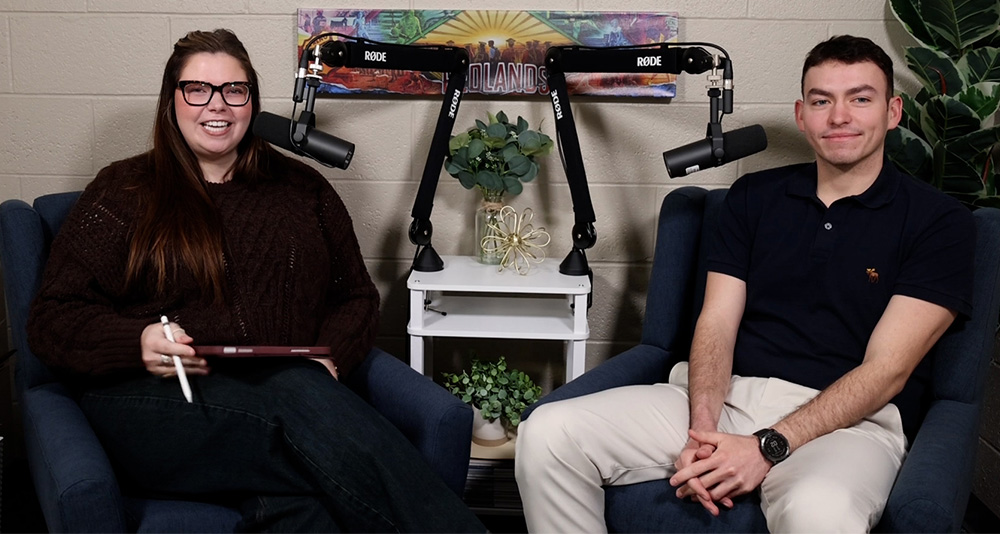
Watch this episode
Transcript
Sydney
Hi everyone, welcome back to Redlands Rundown I'm your host Sydney Dacus and we're
here today with Nathan Dacus, my little brother, actually, and he is going to tell
us a little bit about what he's been doing since he graduated. Redlands Rundown is
the podcast for college, career and everything in between, and we're excited to jump
in and get started today. So, Nathan, if you could go ahead and tell us just a little
bit about yourself, and um like, your degree, your major, what you're doing now and
things like that.
Nathan
So I graduated from Redlands, with an associate's degree in the Fall of 2023, in business
administration. And then I transferred to USAO, and I graduated last December with
my degree, bachelor's degree in economics. I have been, I started my job two weeks
later, I think, and I'm a staff auditor at a bank in the city.
Sydney
Yeah, I remember when you got hired and you had like that two week lull and you were
like, oh Sydney, I just really cannot wait to get to work. And I was like, oh, I'd
really be good at being unemployed because, like, I don't want to, I don't want to
go back. And you were like, I am ready to go, but the thing about education as you
have the break in between. So could you maybe tell us just a little bit about what
drew you to this field that you're in now?
Nathan
So I did, I've, I've always been very detail oriented. Yeah. I really like numbers.
And I did an internship last summer at a bank in Chickasha, and it really showed me
that the part of banking that I like the best was going through the documents, and
either finding, like, the errors or finding information that people needed to help
make them decisions or, you know, my indirect way of being able to help people rather
than, because of all we wanted to find a way to help people in my job. But I knew
that what I was good with was the numbers and the technicalities and the details,
and this kind of let me do both. Yeah. And, I guess really the reason I started so
quickly is I just, I didn't know, it's not that I wasn't qualified for the job, it's
just like the only qualification I was lacking was the, like, needing to have a job
before this, like 2 to 3 years of experience required. But my interview skills, which
I had, you know, attended classes where they prepared me for it kind of helped me,
pushed me through, so I figured I needed to start as soon as I could, so I started
getting experience.
Sydney
You know, I'm glad you said that about wanting to help people, that knowing that really
your strengths like more in the details and the numbers. You've always been really
good at math and you helped me pass my college statistics class. [Yeah.] Shout out
to you. And so I think we already, like, always knew as a family because I remember
you being like eight years old, And telling us, you wanted to be an actuary. So, we
always knew as a family that was probably the direction you were going in. But I think
a lot of people, what they want to do is help people. And so, I think it's really
great that that was also what you wanted to do, but you found a way to do it in a
way that highlighted your strengths. You mentioned that you graduated in December.
What was the transition like going into work almost immediately?
Nathan
I think my advisor at USAO, her name was Professor Hatfield, Doctor Hatfield, she
prepared me for it really well because she gave me a lot of, a lot of power to do
my own work and like, structure things how I needed to, just because she knew that,
how my brain works and how like, sometimes when I get really interested on topic,
I dig in way more than I need to. So the transition was pretty smooth because I went
from already like doing deep dives into certain topics to where really I was just
diving into documents that were already prepared. I didn't have to make them myself.
And yeah, they were different, but like in economics, you're looking at numbers because
you're trying to figure out studies, and if you can use this data, if you can't use
this data. And now in my job, I can use all the data. To me it's not I don't have
to determine if it's if I can use it or not because it's all been prepared. [Yeah.]
So it really wasn't that difficult of a transition. She also let me do like presentations
sometimes during throughout the semester, which helped me be able to like present
to a client. [Yeah.] Essentially, like what my findings were.
Sydney
Yeah. So would you say that you felt prepared for the work field?
Nathan
Yeah. Right.
Sydney
How did your expectations of your first job compare to maybe the reality that you
had traded?
Nathan
Way better. I mean, way better. I always thought that I would work, like at an actual
bank doing something like whether it was, what they call credit administration, which
is where you compare it on documents or being like an internal auditor, which is where
you're really focused on, like the procedures of the bank and how you can help. It'd
be more secure. I didn't ever think that I'd be able to go to like an actual firm
where we get to help a lot of different banks that either, like, aren't big enough
to be able to have their own staff in-house or just find it better use of money to
pay us to come in and help them, which is, it's still very personal because it's like
we're trying to help them figure out how they can improve their business for their
customers. Yeah.
Sydney
Because, currently what you guys do, for those that don't know, is you guys are an
outside auditor who goes into banks...
Nathan
We essentially act as their internal audit or compliance department, which helps them,
for one, follow the law, which very important, necessary, [Yeah,] to some, but also
helps them like notice, like, hey, maybe this part of our procedures isn't strong
enough. And if the FBIC comes in, they're going to have an issue with it, so if we
fix it now because of what our auditors told us to do, we can have it to where they're
going to count it as a positive and not as a negative or just as indifference.
Sydney
So you talked a little bit about that comparison, but what would you say that your
emotions going into the first few weeks of your job were like?
Nathan
I mean, I was, I was anxious, but it was mostly because I had never been like the
youngest person in a place. Especially to the degree where it was like a bunch of
professionals who had been in the field, and I had had, you know, six weeks of experience
going into it. [Right.] A lot of it, too, was just excitement, because I knew that
that's what I wanted to do. Like, I didn't really have that, like anxiety in terms
of, like, I don't know if this is for me. Like, I don't know if it's what I want to
do. It's more like, am I going to be able to do this? And if so, like, how can I get
there faster? Because one of the biggest things for this job was that I need to be
able to learn quick, which has never been like an issue for me. But again, I had never
done something like this, so I was like, it might never be able to pick a business
quickly as I have other things. [Yeah.] And I think that, there's one of the ladies
I work with, she really set me up for success because she just told me, like, you're
on a lot bigger of a timeline than you think you are, because she was like some people,
it takes them two years to fully figure things out. Like, you're not supposed to figure
it out in the first two months.
Sydney
Yeah, I think that's important that you touched on that, because I feel like I remember
graduating college and that emotional whiplash, if you will of: I'm excited, but I'm
terrified. And, either, I have no idea what I want to do, or I know this is what I
want to do, but I'm still not sure that I'm going to be good enough to do it.
Sydney
It is very honest, and I think a lot of us struggle with it because it is like starting
all over again, right? Like you've been doing something for four years and then all
of a sudden you're doing something else for the rest of your life, supposedly. And
so that can be a really intimidating thing. I know, because we're related, that at
the beginning you struggled a little bit with feeling like this was a hard place for
you to be in, right? Like maybe you weren't ready, or maybe you were unsure if you
could figure this out. And so when would you say that you first noticed those feelings
of, like, that imposter syndrome, if you will?
Nathan
Probably, probably the end of my first week there, just because, like the first few
days, at the start of a new job, as I'm sure most people listening, you really don't
do anything. It's more like you're taking you around, getting you set up, making sure
you have all your credentials and everything. But I think really when we start getting
into what all the job encompassed, it was like certain parts of it that I was like,
oh, I definitely can do that because I've done it before, and there were other parts
of that I was like, I don't know if I'm going to ever be able to figure out what this
means. [Yeah.] Because it wasn't like a, because going into it like I thought I had,
I had some expectation, but I didn't fully understand that, like, rather than just
working on you know, one bank, you're working on, you know, 50 plus. So you're not
really like, you're going to have personal relationships with all of them because
you're going to be trying to help all of them. So, it got really overwhelming because
I was like, I'm not just going to be working like with one person, I'm going to be
working with you, a hundred.
Sydney
Yeah. Well dad and I joked when you first got the job, like: Welcome to the real world.
Because everything and, this is none off to you, but everything has always come pretty
easy to you. [Yeah, yeah.] Everything is not always come easy to me. And so I think
it was probably jarring for you. I know it was jarring for you going in and feeling
like I don't know what I'm doing. I don't know if this is what I should be doing.
And we were watching you kind of like: Yeah, buck up, buddy, like, we've done this
before. Like, we, we know that we didn't know what we were doing. But I think you're
not the only person ever to have had a lot of things, and it's not like you didn't
work for it, but you're very smart, and so-
Nathan
I think going in that it's going to be like everything you've ever done and that it's
going to be a smooth transition and that you're going to figure it out. Yeah, and
I'm in a much better place now than I was two months ago, where I still am learning
new things every day. And it's like every time that you think you've got something,
you'll figure it out more, then you find something new and you're like, okay, maybe
I don't have this figured out at all. [Yeah.] So it's been, but, it's almost like
it's, it's become more exciting than scary, just because I've accepted that it's okay
to not understand that. [Right.] And really it's the expectation because, like, now
when I understand something faster, it's more like a, you know, that's great that
you're getting it this soon rather than like a well, yeah, you should have already
known this.
Sydney
Right, and I think that's what we wanted you to know was that that's part of it. Right?
Nathan
Yeah.
Sydney
Like we've all experienced those feelings of okay, I don't know how to do this. And
that's just honestly what life is going to be like a lot of the time. [Absolutely.]
So how did you handle not knowing the things that maybe you felt like you should?
Nathan
I've never had a problem asking people questions. And, [That is true.] yeah, I think
that a lot of people get really nervous and think that, like, I can't ask this question
because it sounds stupid. [Yeah.] I've never had that problem because I always have
thought that, like, if I want an answer, I'm gonna have to ask someone like, I can't
always figure it out myself. So, probably having to ask a lot of, not like, you know,
silly, like repetitive questions, especially like my first, you know, 2 or 3 weeks
there. [Yeah.] Just because I wanted to learn everything I could before the start
of the year, because that's when I knew that, like, things would actually pick up.
So I use my first two weeks as more of like a: I'm going to ask every single question
that pops in my head, at every chance I get. [Yeah.] And I, and I also did it like,
I get to work for home a lot, but the first two weeks, I was mostly in the office.
So, I spend that time efficiently, like asking in as many questions in person as I
could, because sometimes it's hard to answer the email. But like most people have
time for, you know, five minute conversation in their office.
Sydney
Yeah. When I, because I also work at USAO, which is where you got your bachelor's
from, and when one of your professors told me that she loved having you in the class
because you were always asking questions and you were always raising her hand, that
was my biggest nightmare. And I was like, God, I hope he learns to shut up, because
I'm glad you ask questions, but that's like my biggest fear is for someone else to
know that I need help with something, right? And so I think it's really great, and
I hope it's encouraging to people to hear that, it's okay to ask questions. And also,
you'd rather ask questions and do it right than mess it up for months and then later
on the road be like, oh, I guess I could have just asked.
Nathan
Yeah, and well, I think especially like in high school, everyone saw me is like the
person with the good grades, who didn't [The nerd.] Yeah, yeah. Who didn't need to
try as hard, but it was really that I was willing to ask any question that popped
into my head, even if it was like something that everyone else had answered and I
should have. Yeah, I would just go in and say, hey, I don't understand this. Like,
and I don't just want the answer, like, can you explain to me how I'm, how I get the
answer?
Sydney
Which the other thing with that is there were probably several students who were wondering
the same thing, who were scared to ask, because there were a lot of times in class
that I was like, I really hope someone else [will ask,] will raise their hand. Because
I'd like to know, but I'm not gonna ask. So how would you say that learning on the
job, like you've been talking about, is different than you having to learn in the
classroom?
Nathan
In the classroom, it's a lot more of a controlled environment because like the books
that you're learning from or the information, well, I say that, most of the materials
are learning from, like in my degree field at least, have been around for hundreds
of years. So, like, the information is everywhere. It's readily available. There was
a few variables just because like since I was in economics, I was doing like data
analysis of stuff that had come out like, you know, five years ago that really wasn't
on record. And all the job learning, it's like, there's humans involved, like other
people involved. It's not just you and books. It's like, on the job, it's like, not
only are you having to learn all this and like, yeah, the information has been out
there for a while, [Yeah.] just because of all the regulations. But like, you're having
to also factor in like, I don't want to overstep on someone else's boundaries, and
I don't want to seem like I'm trying to be mean asking this person a question because
email, it's a lot easier, it's easy to come off mean and like because like, I've even
gotten emails where it's like, I'm pretty sure this person, I-
Sydney
Like, do you think you're aggressive in emails? Because I'm starting to worry that
you're sending the worst emails.
Nathan
When I ask questions, I ask questions. I'm not gonna dance it because I would prefer
people to be direct with me.
Sydney
Yeah, I think I use like seven exclamation points on a smiley face.
Nathan
But like, and like people on my team, like, they're just going to ask me directly
what they either need me to do or what they, like well, want me to send them. [Yeah.]
Compared to, like with these banks, it's like, I can't just say that because I don't
want them to think that me, like, because to me, it's being direct. To them, it could
think, this person thinks I'm stupid.
Sydney
So essentially like, I guess the difference for you probably is that in college, you're
learning for yourself and then your job, you're learning for yourself, but also what
you learn affects others.
Nathan
Yes. I mean, everything I do pretty much affects other people because it's like, not
only am I doing my job, I'm critiquing them on how they did theirs. [Yeah.] And I've
never been in that position before.
Sydney
Sure. So, what's it like for you, we talked about this just a little bit earlier,
but what's it like for you being one of the newest or youngest members on your team?
Nathan
For me, I think just because having older siblings and-
Sydney
For those that don't know, you have three older sisters. [Three older sisters.] Yes.
So you're used to being bossed around and told what to do.
Nathan
I told my boss-
Sydney
But in a controlled environment.
Nathan
My boss, my first, or one of my bosses, the first day I said, listen, I have three
older sisters, so you can just tell me what you all want me to do and I'll do it.
I'm going to ask questions because I've learned better. [Yeah, Stupid mistake.] Yeah,
yeah. So I guess it's really it's been weird at times, but like also kind of exciting
just because, like, they took this chance hiring me when there was really like, yeah,
I mean, yeah, I had strong, like a strong resume and I had good recommendations, but
like, I had no experience.
Sydney
Yeah. And I would like to talk about that for a minute because I, if I'm remembering
correctly, you didn't actually have all the qualifications.
Nathan
Yeah, I was missing, well so, on the job description, [Yeah.] it wanted 2 to 3 years
of experience and it said required, I think. It's either said required or, you know,
[recommended?] recommended or something. But it wanted people with either like a business
degree or an accounting degree, and it said like or related. But like economics is
not something they really throw in there. But I mean, there's people at that, at the
bank, that have economics degrees and they basically were like, that's the, both.
You do both things in those. And then I, like, because they just asked me like, have
you ever taken, you know, accounting classes? And I was like, yeah, like if it was,
you know, 20, 2009, I could sit for the CPA. I just, I, they but-
Sydney
So do you feel it's been intimidating for you to be the youngest on the team?
Nathan
At times. It's also been exciting just because that means that everyone else knows
more than I do. [Yeah.] Which means that I can ask them questions that I have. Yeah,
because again, I-
Sydney
Love to bother people.
Nathan
Yeah. I mean, the only way I can learn is by asking someone who knows or by researching
it. [Right.] And researching it requires to look into a regulation that might be 400
pages long and asking something as simple as saying, hey, like, I don't fully understand
this when you get a chance, can you [Yeah.] like help explain it to me.
Sydney
So really, for you, like being the youngest or the newest, in a lot of ways, that's
kind of been a good experience and even maybe a benefit to the job?
Nathan
I think it's been way more beneficial than I would have imagined, because it's not
it hasn't been viewed as like, oh, you know, he doesn't know what he's doing. It's
been more like a we can teach him how to do things the way that we think it needs
to be done.
Sydney
Yeah. This next question is, did you ever hesitate to ask questions? And I think we,
yeah.
Nathan
Yeah. I think we covered that.
Sydney
No, never, not in this lifetime. But, for maybe people that feel like they shouldn't
ask questions because they don't want to look inexperienced, what do you think drives
you and makes you feel confident doing that? Is it just that at the end of the day,
you need to know the answer?
Nathan
I think it's a little bit of that. More so is that, when you ask a stupid question
in your brain, as soon as you ask it, it's not a stupid question anymore because you
know the answer. [Yeah.] So then it goes from being like, oh, I can't believe I asked
that to like, I'll never have to ask it again. [Yeah.] So, it's just a one time, you
know, they say bite the bullet and then you get to move on knowing more than you did
before. So, it's really not a, and people that really know the answers and that you
view as smarter than you, aren't going to laugh at you for asking any questions because
they only got there by asking thousands of stupid questions.
Sydney
That's a good way to look at it. But, how have you, like maybe your coworkers or even
your supervisors, have helped ease that insecurity that maybe you've had in this job,
or even if they've made it worse sometimes?
Nathan
I think all they've done is ease it, just because, like, for me, the way I learn is
getting thrown into something and having to, like, figure it out and do the research
of my actions, as I'm actively participating in it. And I think that they really helps,
like, because I've only been there for, er, two months, but there's been three different
things that I've gotten to do mostly on my own, and it's really helped me learn like,
oh, you know, if this happens, then there's these options, how to handle it. [Yeah.]
And also, I know that I can ask someone for help without having to worry, like that,
they're too busy because they've told me like, hey, do you have any question: either
email, call, like, you have our phone numbers, like, [Yeah.] whatever we need to do
to help, we'll do our best.
Sydney
So you have really supportive people?
Nathan
Very supportive people.
Sydney
What would you say, maybe when you have a hard day on the job, like at the end of
that, what helps you rebuild confidence and to go back in there and feel like I know
how to do this?
Nathan
I usually look at things like on a day-by-day, so like as soon as that bad day's over,
that hard day's over, it's over. [Yeah.] I know, I try not to think about it, I tried
to stay-
Sydney
Days gotta end, Right?
Nathan
It's gotta end. I mean, I think because, like, compartmentalization is important in
a lot of ways. [Yeah.] And I think it's important to, like, keeping your mood better
just because, like, you don't need to carry in a bad Monday into a Tuesday morning.
[Yeah.] Because like, it's not just going to affect you. It's going to affect people
around you. [Yeah.] So, if you can just say like, yeah, it was a really rough day,
but like tomorrow's has a chance to be better. Even if it's still bad, it may not
be as bad as the day before. [Yeah.] So, like whether you need to look at it as, like,
a day-to-day or a week-to-week, like, it's gonna, it's gonna get better. I mean-
Sydney
That's a great attitude. I would never do that. We're just, [Minute-by-minute.] Yeah.
A minute by minute, really. And I think that's very realistic is that sometimes that
is how your job goes, is you have a really tough day and you kind of have to say,
okay, well, maybe today will be better or tomorrow will be better. And if it's not,
then maybe the next day will.
Nathan
Well, and it's, it's like because sometimes when you're having to learn everything
on the fly, it's going to get so overwhelming, where you're like, I don't even know
what I learned today. [Yeah.] And you're just sitting there like staring at your computer
thinking like, I don't even know what I accomplished, so I have to get away from work.
Sydney
Right? And I think also, one, that day doesn't mean that's not where you're supposed
to be at. [Yeah.] And so that's something important to keep in mind too. When would
you say that, during this job, that maybe you've started to feel a little more comfortable?
Nathan
Probably two weeks ago. [Yeah.]
Sydney
So, like a month and a half in?
Nathan
Yeah, a month and a half in. Well, I say that, really, just like a full month in,
because, like, I started my first audit that I did was at the beginning of January,
and then I got like a week and a half or two weeks before my next big one. So I got
to really, like, sit down and like, realize, like I did it, like I finished it. I
did it mostly on my own. [Yeah.] Like, I can do this. [Yeah.] Like, all it's here,
like, they're going to get bigger, but like, as long as I just stick to the scripts
and, you know, like, work, try hard and ask for help, I can figure it out.
Sydney
Yeah. That's great that like, those accomplishments continue to drive on. How can
you graduate, graduates give themselves grace, maybe, in those beginning stages? So,
like, for you, you automatically got a job. For me, my, my situation, when we lived
in Durant, I graduated, I took my gap year and, which was on purpose-
Nathan
Backpacking across Europe?
Sydney
Yeah, something like that. Laying on my couch watching Netflix and-
Nathan
Suits is a great show.
Sydney
And then I got a job. But I feel like I wasn't very good at giving myself grace. Or,
maybe I gave myself too much grace? Maybe that was always, because I was like, I'll
get in job. [I'll figure it out.] Yeah, but what would you say, for you, maybe has
been helpful and would you want other students to know? Grace wise.
Nathan
I think that you have to learn to leave the job in either your office or, you know,
if you have an office at home, leave it in that room because the second that you carry
it into your evening, it's going to just control your life because how that day would
how, you know, maybe it's your coworker that got up, so was having a bad day and took
it out on you, or maybe it's someone from the bank that, you know, didn't understand
what you were asking. You know, not that they lashed out, but they, you know, sent
you an email that you thought, well, they, they think that I don't know what I'm talking
about. [Yeah.] I think you just have to say like, it's over. Like, the day is over.
I don't have to carry this into my evening because I'm not what my work is. I still
get to be, like, myself. [Yeah.] And for me, it's having hobbies is extremely important.
Just because then I don't have to think about the mistakes I made or like what I should
have done better. I can just be like, it's going to be there tomorrow. [Yeah.] It's
going to be there next week. I have time to figure it out. I don't need to think that
just because I didn't do this today means that life is going to end.
Sydney
Yeah, I feel like that really ties back in to what you were saying earlier, is taking
it day-by-day, minute-by-minute, if that's what it takes. And I think like speaking
from experience, it can be really easy to get down about something that you stay that
way. I think you have done a really good job at separating, like, this job is not
my life. And I think that's very important because your job is important, but also
it's not who you are at the end of the day. And I think that's a really great way
to be able to find a way to say I do deserve some grace here, because who I am from
8-to-5 is not who I am. [Well,-] As a whole.
Nathan
For me, it's always been, I hope at my funeral, they don't say you were a great auditor.
Sydney
You were really good at your job!
Nathan
If they say that-
Sydney
I mean, that's what I'm going to say, I'm definitely going to outlive you, and that's
what I'm going to say.
Nathan
But like, if that's what people have to say about me then, I didn't do anything that
I wanted to do. [Yeah.] Like, I just only let my life control me. And that means that
the people around me were affected negatively and I, I never want to be a person who
does that.
Sydney
So what would you say, as a closing reflection, like what confidence means to you
now, even if maybe you're still growing in that at work?
Nathan
I think it's more the confidence that I have now is the confidence that I've always
had, I just didn't realize it, because the confidence to ask the repetitive questions
has given me more confidence about, like knowing and like starting to understand or
at least scratch the surface of like what I need to do. [Yeah.] And it's like people
told me like, hey, we used to reference this stuff. It's not like you've got to memorize
it. And that's really helped me because I've always been like, I, I have a good memory.
So I've always thought like, well, you know, you could memorize these things and it
makes it way easier. Well now, I'm going to use all the materials I can because that's
what they're there for. Like, I don't need to feel like just because I used the book
means that I can't do it. It's more like I'm going to use every piece of the book
that I have.
Sydney
Right, like that's what they're there for.
Nathan
Otherwise they wouldn't have given me these resources.
Sydney
Yeah, well, I love that. I think it's a good reminder that even though those feelings
of going into the job and just graduating college, those things are very real, but
so is the fact that there's excitement that comes with starting something new. There
is a way to build confidence with starting something new, and there's a lot of good
on the other side of that. I don't have anything else for you. But I'm really glad
that you came on. I'm going to let everyone know if they want to be on the podcast,
they have to be related to me. Nepotism is real. It's alive and well. But really,
I am thankful that you came on and you got to tell us a little bit about just what
this has been like, because it has been a transition, and it's a transition that a
lot of our students are going to see in the coming weeks, months, years. And I hope
that they take this and realize, like, it doesn't have to be scary, even though it
is at the beginning.
Nathan
Yeah. Well, and also don't think that just because I only took a week and a half off
between graduating and starting my job, that doesn't have to be the path, right?
Sydney
Everyone's is different.
Nathan
If the, for the people that know me, that was the only path that made sense because
I don't do well with downtime. [Yeah.] Some people need downtime to decompress and
like appreciate that, hey, I just did one of the coolest things ever. I just graduated
college. I mean it's a big accomplishment, yeah.
Sydney
And they kind of, actually, I needed that time, to sit in that accomplishment.
Nathan
Yeah. And for me, it's always been like, I've always been so accomplishment driven
that I just saw it as like another check mark on the box, not to what it really was.
[Yeah.] So, like, I really didn't appreciate it until like two weeks ago when I was
like, oh my gosh, when I picked up my degree.
Sydney
I was about to say-
Nathan
I was like, hey, this is cool. But like in the moment, I was just like, you know,
yeah, that was what it was expected. But like, it really is a cool thing.
Sydney
And I think the other thing that's exciting is that learning is forever. And no one
can take that knowledge from you. And I hope that you're getting to experience that.
And it sounds like you are, because you're talking a lot about, you know, even though
I feel like maybe I should know these things, that's what learning is. So I hope that's
what our listeners can take away from this today. And I hope you guys tune back in
to our next episode and hoped you enjoyed this one with my little brother, Nathan
Dacus. Thanks, guys. See you next time.